
Cell Phone Plans in Ontario
All 190 plans here are sold in Ontario, from 18 carriers. Prices are what each carrier advertises; every card also shows the monthly cost with HST (13%) added.
Try removing a filter or
Cell phone plans compared





What you pay on top in Ontario
Plan prices on this page are what carriers advertise. Your bill adds HST.
- Sales tax
- HST 13%
- Applies to
- Plan price and carrier fees
- 911 fee
- None
Common questions
What tax do you pay on a cell phone plan in Ontario?
Ontario charges HST at 13% on cell phone service. It applies to the plan price and to any monthly fee the carrier adds. Most carriers advertise prices before tax, so your bill is higher than the number in the ad.
Is there a 911 fee on a Ontario phone bill?
No. Ontario does not add a separate monthly 911 fee to cell phone bills, so the plan price plus HST is what you pay.
How much does a $50 plan really cost in Ontario?
On a $50.00 plan you pay $6.50 in HST, so the bill comes to $56.50 a month. Some carriers include tax in their price; their plans are marked on this page.
Why do plans differ between provinces?
Carriers set some plans and promotions by province, and some smaller carriers only sell in one region. This page lists only the plans sold in Ontario, so every plan here is one you can buy with a Ontario address.
Rates checked October 20, 2026.
Also shopping for a phone?
Browse phones & reviews
Every phone reviewed and ranked by our editors. Find the right one, then come back and pick your plan.


Save with a certified refurbished phone
Same phone, $300 less. We compare every certified seller — Back Market, Amazon Renewed, and eBay Certified — in one place.


Browse carriers by network
The cheapest carriers run on the same towers as the Big 3. Pick a network, see everyone on it.
Canada has three national networks, run by Bell, Rogers and Telus, plus regional ones such as Freedom Mobile, Videotron and SaskTel. Most budget brands run on one of the big three, so the coverage you get depends on the network, not the brand name on your bill.










Carriers on the same network share the same towers, so where you get signal matches. What differs: data priority when a tower is congested, perks, and customer support. We note these on every plan card.
Switching from your current carrier?
Not sure where to start?
Our team breaks down the plans worth considering across every network, budget, and use case.

How to stop overpaying for your cell plan
Canadian wireless bills are among the highest in the world, and plenty of people pay more than they need to. Four things explain why people overpay. Here’s how to read past them.
Carriers advertise the base price, before the autopay discount you may not qualify for and before sales tax, which adds 5% to 15% depending on your province. A $65 plan can land near $75. Every card shows the advertised price and the cost with tax for your province.
Unlimited plans don’t cut you off, but most slow your data after a monthly priority threshold, especially when the network is busy. Premium tiers raise or remove that cap for more money. In dense areas at peak times, standard-priority data can drop below 1 Mbps.
Fido, Koodo, Virgin Plus, Public Mobile, Lucky Mobile and others run on Bell’s, Rogers’ or Telus’ towers, so coverage is usually the same. The tradeoffs: lower data priority during congestion, fewer (or no) retail stores, and sometimes no phone financing. Weigh those against the price gap.
A plan that costs $85 for one line can fall to $45 to $50 per line across four lines. So a carrier that looks “more expensive” can be cheaper per line for a household. Always compare multi-line pricing. Our cards expand to show 1-, 2-, and 4-line costs.
Before you pick, ask three questions: Does it require autopay? Is the price before tax? Is there a monthly carrier fee? A $40 plan costs about $45 in Ontario once 13% HST is added, and more in Nova Scotia at 14%, so compare the price with tax for your province.
Usually, yes. A smaller carrier that runs on Bell’s, Rogers’ or Telus’ network uses the same towers, so your map of dead zones mostly doesn’t change, though some budget brands leave out rural areas or roaming. The one real difference is during congestion: budget customers’ data can be slowed when a tower is busy, which you may notice in crowds or dense city blocks. Check the brand’s own coverage map for the places you go most.
An MVNO (“mobile virtual network operator”) is a carrier that sells service on a major network’s towers instead of building its own, which is how it charges less. The catches are real but narrow: your data may be slowed before the network’s own customers during congestion, there’s usually no retail store to walk into, and most don’t offer phone financing. For a lot of people the monthly savings outweigh those tradeoffs, but they’re worth knowing going in.
Usually, yes. Phones sold in Canada since December 2017 come unlocked, and carriers must unlock older ones for free. The thing to confirm is that your phone supports the new carrier’s bands, which matters most for regional carriers like Freedom Mobile. Our plan cards flag compatibility, or you can check your phone’s IMEI on the carrier’s site before you commit.
Probably less than you think. If you’re on Wi-Fi at home and work, 5 to 10 GB a month covers normal browsing, maps, music, and social. Heavy video streaming on cellular, regular hotspot use, or little Wi-Fi access is what pushes you toward unlimited. The fastest way to know: check your last few bills, where your current carrier shows your real monthly usage.
Yes, and it’s free. CRTC rules require carriers to transfer your number. One tip: don’t cancel your old service first. Start the switch with the new carrier and let them pull (port) your number over, which usually takes minutes to a few hours. You’ll need your account number from your current carrier, and sometimes your phone’s IMEI.
An eSIM is a digital SIM built into your phone, with no physical card to swap, so you can activate a new plan in minutes by scanning a code. Most iPhones from the XS (2018) onward and many recent Android phones support it, and most Canadian carriers now offer it. Check Settings for an “Add eSIM” or “Add cellular plan” option, or look up your model to be sure.
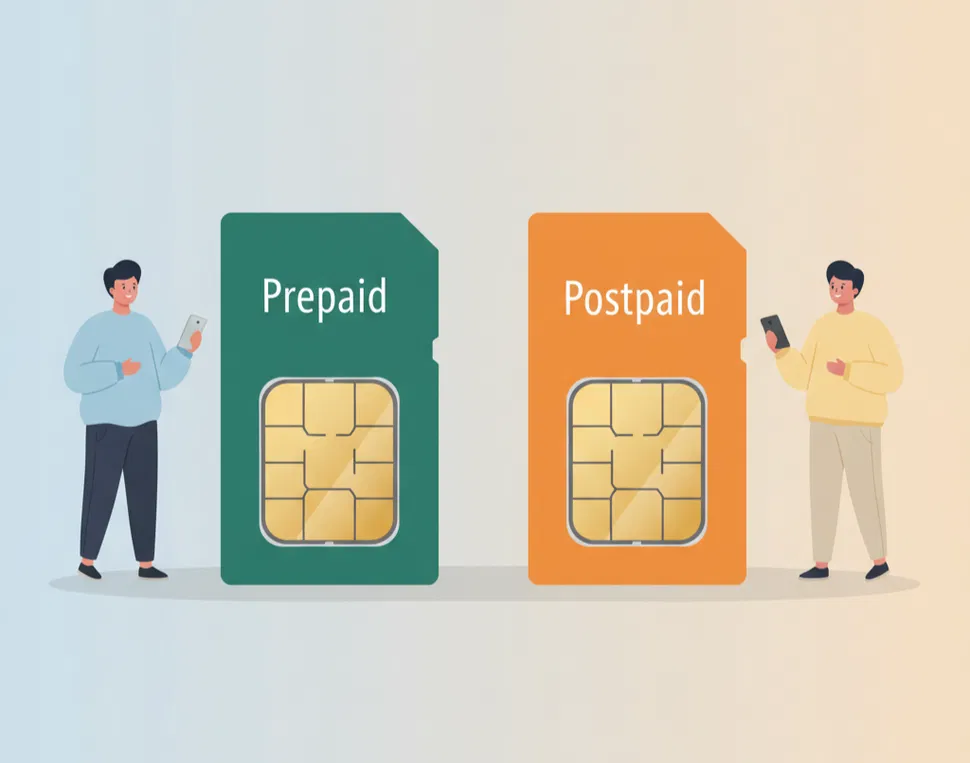
Neither is “better”; they suit different people. Prepaid means you pay up front, with no credit check and no contract, so it’s good for avoiding commitments or capping your spend. Postpaid bills you after the fact, runs a credit check, and tends to bundle perks and phone financing. For the same data, prepaid is often cheaper; postpaid can win if you want a subsidized phone or multi-line perks.
Mostly sales tax. Depending on your province, GST, HST, PST or QST adds 5% to 15% to the advertised price, plus a small 911 fee in some provinces. A few carriers also charge a monthly fee of about $1 to $2. That’s how a $30 plan ends up near $34 in Ontario. Every card shows the advertised price and the cost with tax for your province.
Not exactly. Unlimited plans won’t cut you off, but most slow your data after a monthly priority threshold, often somewhere between 30 GB and 100 GB depending on the plan, especially when the network is busy. Premium unlimited tiers raise or lift that cap for more money. For most people the standard tier is plenty; heavy users should check the priority-data cap before choosing.
Carriers can't pay for a better ranking.
To ensure accuracy, this page has been reviewed and fact-checked by Carl Perlas, Jon Stone and Branden S. as part of our editorial review process. Learn how we score.